Building and retaining great teams

For growing organizations, hiring is a key source of competitive advantage. Bringing the right people in and setting them up well once they join directly affects performance, retention, and long-term growth, particularly in challenging labor markets.
This guide sets out a clear, practical approach to hiring, from defining a role through to making an offer and onboarding. It draws on practices we have seen work well and is designed to help organizations attract strong candidates, make sound hiring decisions, and retain great people.
[If you would like the PDF version, contact james@forecasthc.com]
Contents:
- Clarify the role and define success.
- Position level and pay considerations.
- Establish clear and objective selection criteria.
- Decide how you will assess the criteria.
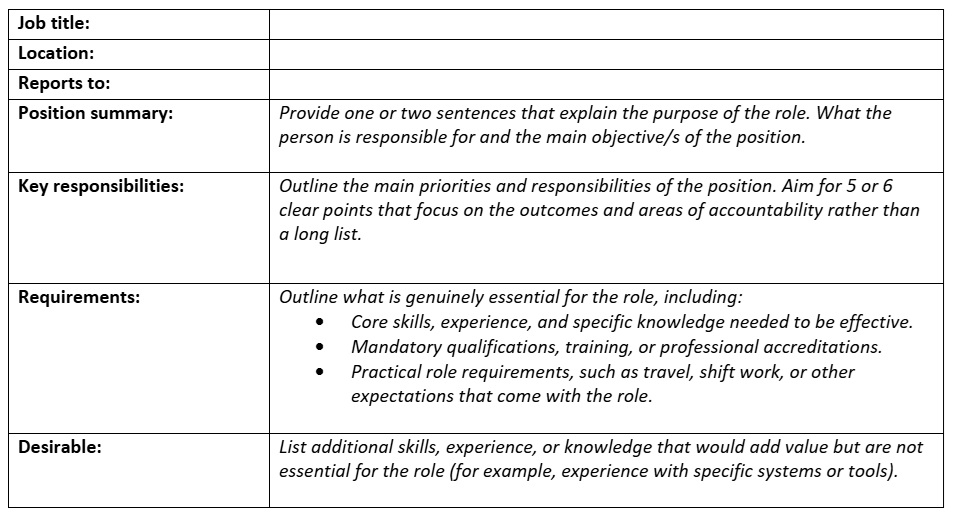
- Write the job description.
- Work in partnership with your recruiter.
- Assemble the interview panel.
- Prepare for structured and consistent interviews.
- Conducting interviews with evidence in mind.
- Assumptions, impressions, inferences, and observations
- Handling internal candidates.
- Debrief and evidence-based decisions.
- Making offers, negotiations, and managing rejections.
- Onboarding new hires.
- Equity, diversity & inclusion in hiring.
APPENDIX

1. Clarify the role and define success
Before opening a role, take time to think through what the team actually needs and what success would look like.
Replacing a role exactly as it was may not always be the right approach. Business goals change, priorities shift, and hiring moments often create room to adjust responsibilities, skills, or scope to better support future work.
Questions that help at this stage:
- What outcomes is this role responsible for?
- What would “doing well” look like in the first 6–12 months?
- Which skills and behaviors really matter for success?
- How might this role evolve as the team or organization grows?
- What opportunities exist for the individual to develop new skills, take on additional responsibilities, or progress within the team and organization?
Clarity here makes every step that follows easier and more effective.

2. Position level and pay considerations
Before the role is approved, be clear on the position level and intended pay range.
Position levelling defines the scope, accountability, and impact of the role. Getting this right early helps ensure fairness, consistency, and clarity for both candidates and the team.
Incorrect levelling can create misalignment in the team, pay inequity, and difficulties later when assessing candidates or making offers.
When setting level and pay:
- Compare the role with similar positions in the team or organization.
- Consider internal pay relationships and team structure.
- Consult your Talent Acquisition or HR team for levelling, benchmarking, and internal alignment.

3. Establish clear and objective selection criteria
Once the role is clear, define what matters most for success. Clear selection criteria provide a shared reference point for shortlisting, interviews, and final decisions.
Selection criteria typically include:
- Required criteria: Skills, experience, or qualifications that are essential.
- Preferred criteria: Attributes that add value but aren’t critical.
- Competencies: Observable behaviors linked to effective performance.
- Values or ways of working: How the role is expected to work with others and operate within the team and organization.
- Growth potential / learning agility: Does the candidate have the capacity and desire to develop new skills?
Keep the criteria focused and realistic. A long or overly specific list narrows the candidate field unnecessarily, while vague criteria make decisions harder to justify.
Where possible, agree the criteria with others who will work closely with the new hire.
Tip: Limit the number of competencies and assess them consistently using competency-based questions.
(Forecast HC competency question bank)

4. Decide how you will assess the criteria
Once the selection criteria are agreed, consider how each will be assessed. Not all roles require the same assessment approach. Choose methods that give you reliable evidence about a candidate’s ability to do the job. This makes it easier to compare candidates based on evidence rather than impressions.
Common assessment methods include:
Structured interviews:
The most common assessment tool. Be clear on the number of interview stages from the outset. Adding extra stages partway through the process can frustrate candidates and slow decision-making.
Practical or work-based assessments:
Tasks, presentations, case studies, or exercises that reflect real aspects of the role and provide direct evidence of how a candidate approaches the work.
Psychometric or ability testing:
These can assess cognitive ability, personality traits, or specific aptitudes. They should be relevant to the role, used consistently, and interpreted carefully alongside other evidence.
Staff Engagement Exercises (SEE):
These involve guided discussions with a group of staff (such as future colleagues, potential direct reports, or stakeholders). They’re designed to explore how candidates communicate and engage with others, as well as leadership style and alignment with organizational values.
If using assessments alongside structured interviews:
- Be clear with candidates about what the task involves, what is being assessed, and
how it will be used. - Assess all candidates consistently against the same criteria.
- Be mindful of time and accessibility, particularly for take-home tasks.
Tip: The best approach typically combines structured interviews with one practical element. This provides evidence from different angles while keeping the process manageable.

5. Write the job description
The job description translates the role and selection criteria into something clear and easy to understand for both internal and external candidates.
A strong job description:
- Focuses on the most important responsibilities and outcomes.
- Describes what success looks like, not just tasks.
- Uses clear, neutral, inclusive language.
- Avoids internal jargon, acronyms, or requirements that aren’t essential.
- Doesn’t include assumptions about background unless truly necessary for the role.
A well-written job description helps candidates self-assess and supports more effective sourcing and screening.
Resources: Tools such as Textio, Grammarly, and Datapeople can help check the tone, language, and content of job descriptions to ensure they are written in plain language and appeal to a broad audience. Your recruiter or HR partner can advise on availability and access.

6. Work in partnership with your recruiter
Recruiters help identify and screen candidates against the agreed criteria, including soft skills, experience, cultural fit, and key considerations such as motivation, remuneration, and location.
Early conversations help align on:
- Role priorities and selection criteria.
- Hiring strategy and sourcing approach.
- Best practice and legal compliance.
- Timelines, expectations, and feedback loops.
Working closely with your recruiter maintains momentum and supports timely decision-making, which are critical to both candidate experience and hiring outcomes.
Tip: It can help to agree on two or three specific questions for your recruiter to cover during screening calls. The responses give you early, comparable signals across candidates and are particularly useful for technical or specialist roles.
Tip: When exploring candidate motivation, go beyond reasons for leaving or interest in your role. Understanding what they enjoy most about their current job can reveal expectations and help determine whether the role you are offering is a good fit.

7. Assemble the interview panel
Interview panels are most effective when they are deliberate and balanced.
When selecting panel members, consider:
- Who understands the role and the work involved.
- Who will work closely with the new hire.
- Who can bring a different perspective and challenge assumptions.
- How the panel reflects a diverse range of experiences and viewpoints.
Keep the panel consistent across all candidates to support an equitable process and meaningful comparison. Be mindful of panel size and structure, and its impact on the candidate experience.
Tip: Many organizations encourage all interview panel members to complete unconscious bias and diversity and inclusion training. Below are two LinkedIn Learning courses that are commonly recommended:
- Unconscious Bias: https://www.linkedin.com/learning/unconscious-bias
- Diversity, Inclusion and Belonging: https://www.linkedin.com/learning/diversity-inclusion-and-belonging-2

8. Prepare for structured and consistent interviews
Prepared, structured interviews help get the most out of the time available. This approach supports consistency, equal treatment, and makes it easier to compare candidates and explain decisions.
Before interviews:
- Ensure all interviewers understand the role, selection criteria, and competencies to be assessed.
- Review candidate information in advance.
- Create a list of competency-based questions to ensure consistency across all interviews.
- Agree on which competencies, criteria, or questions each interviewer will focus on to avoid repetition.
- Encourage panel members to focus feedback on specific evidence, not impressions.
Competency-based questions encourage candidates to give examples of how they’ve handled situations similar to those they might face in this role. Listen for how they demonstrate the behaviours and actions outlined in your selection criteria.
(Forecast HC competency-based question bank)

9. Conducting interviews with evidence in mind
During interviews, aim to create the conditions for open, reliable evidence. Clear communication about the role helps candidates give more accurate and relevant examples.
- Confirm role understanding: Ask the candidate how they interpret the role and its requirements. This helps confirm alignment and whether the job description is coming across as intended.
- Set context for the role: Explain why the role exists, the impact it has, and how it may develop over time, including learning or progression opportunities.
- Be open about challenges: Outline constraints, pressures, or upcoming change so candidates can respond with informed, realistic examples. This also helps to manage expectations.
Once context is set, focus on gathering evidence:
- Explore what candidates did, how they did it, and why.
- Listen for specific examples, actions, and outcomes (observable behaviors).
- Capture concrete examples linked to the selection criteria and competencies.
- Be aware of assumptions, impressions, and inferences forming and test them against evidence (see the framework in Section 10).
This approach supports trust and expectation setting while maintaining a focus on evidence. It enables fair comparison across candidates, reduces the influence of unconscious bias, and makes it easier to reach well-reasoned, defensible decisions.
Legal compliance: Questions must be job-related. Avoid personal topics such as age, family status, religion, health, or other protected characteristics. Ground decisions in criteria and observable evidence. Consult your HR or recruiter for region-specific requirements.
Standardization: Keep questions, the environment, and interviewers the same for all candidates to ensure consistency.
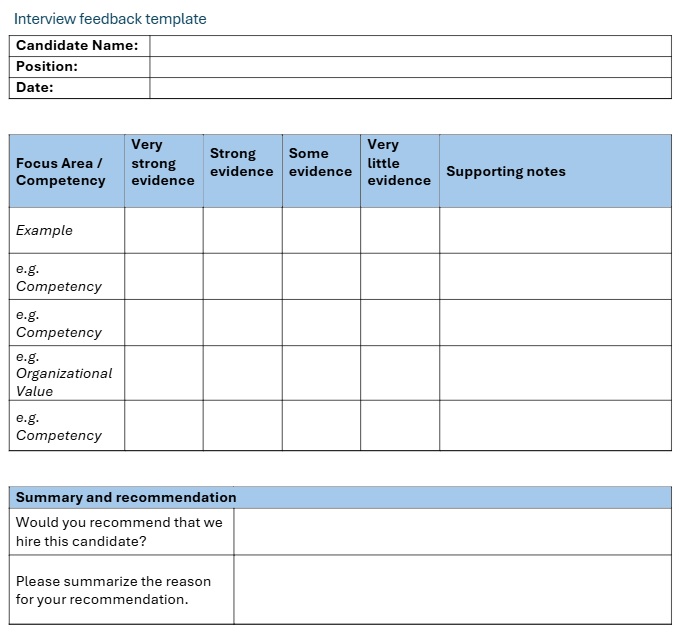
Note-taking: Where possible, all interviewers should use a standardized feedback template. This keeps notes clear, consistent, and easy to refer back to.
Important: Be mindful about what you write down. In some regions, including those subject to GDPR and similar data protection laws, candidates may request access to interview notes. Focus on factual observations and avoid subjective or inappropriate comments.

10. Assumptions, impressions, inferences, and observations
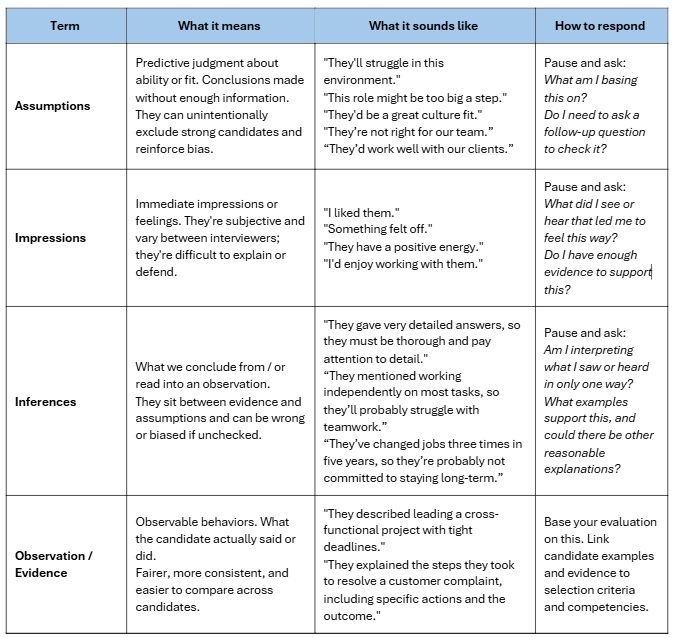
Interviews rarely provide complete information, so it’s natural for assumptions, impressions, and inferences to form. However, they shouldn’t drive decisions on their own.
A helpful check is to ask:
- “What did I actually observe?”
- “What does that suggest?”
- “Is there enough evidence to support it?”

11. Handling internal candidates
Internal and external candidates bring different considerations to the hiring process. Both should be assessed equally against the same criteria, while recognizing their different contexts.
Managing the process objectively:
- Post roles internally according to policy, either before or alongside external advertising.
- Use the same selection criteria and interview structure as for external candidates.
- Be aware of familiarity bias. Having more information about internal candidates shouldn’t replace evidence from the interview.
- If you have a strong internal candidate but are also testing the external market, be transparent about the process.
- Provide timely, clear, constructive feedback to internal candidates who aren’t successful. Be transparent about how the new role differs from their current position, identify development areas and next steps.
Be mindful of perception. If internal candidates keep losing out, people might start feeling that promotions or moves aren’t fair, which could damage morale or trust in the process.
12. Debrief and evidence-based decisions
Post-interview, hold a structured debrief with all panel members and the recruiter.
- Encourage specific, factual feedback rather than general impressions. This also helps recruiters provide clearer feedback to candidates.
- Compare observations, examples, and evidence against selection criteria.
- Identify strengths, gaps, and potential risks based on evidence, not impressions.
- Check inferences against the evidence.
- Challenge assumptions and impressions constructively.
Well-reasoned decisions are easier to explain, justify, and stand behind.

13. Making offers, negotiations, and managing rejections
Making the offer:
Once you’ve selected your preferred candidate, work with your recruiter or HR partner to prepare a formal offer.
- Ensure the offer aligns with the approved level, pay range, and internal equity considerations.
- Consider the full package, not just salary. Benefits, flexibility, development opportunities, and team culture all matter.
- Speed matters, especially for competitive candidates. Discuss timing with your recruiter or HR partner.
Handling negotiations:
It’s common for candidates to discuss elements of the offer. How these conversations are handled can shape their experience and perception of the organization.
- Find out what matters most to the candidate (it may not always be salary).
- Be clear about what’s negotiable and what isn’t, based on organizational policy and internal equity.
- Consult with your HR partner before agreeing to changes, particularly around compensation.
- Keep negotiations timely, as prolonged back-and-forth can signal indecision.
Managing rejections:
- Notify unsuccessful candidates as soon as a decision is made. Delays damage your employer brand.
- Ensure your recruiter has clear feedback to share, as they often handle these conversations.
- Focus feedback on evidence and selection criteria, not personal judgments. Be honest but constructive, highlight strengths as well as gaps.
Tip: Candidates who feel respected in rejection are more likely to reapply, refer others, or speak positively about your organization. Competitive advantage comes by doing the things that are sometimes overlooked by other organizations.

14. Onboarding new hires
The hiring process doesn’t end when the offer is accepted. A thoughtful onboarding process sets your new hire up for success.
Before the start date:
- Stay in touch before the start date. A brief check-in reassures new hires, maintains engagement and reduces chance of “drop-offs”.
- Work with your HR partner to ensure all pre-employment requirements are completed (contracts, right to work, security clearances, references).
- Prepare the team for the new hire’s arrival. Communicate their role, start date, and initial focus areas.
- Assign an onboarding buddy or mentor where appropriate.
- Prepare workspace, equipment, and IT access.
- Plan the first week, including introductions, key meetings (customers, stakeholders etc.), and early priorities.
First day and week:
- Meet with your new hire on day one to welcome them personally.
- Review the role, team structure, and immediate priorities together.
- Discuss short- and longer-term development goals. Outline potential projects, training opportunities, and progression paths within the team or organization. Clarifying career expectations early helps set people up for success and supports retention.
- Introduce them to key colleagues and explain how the team works together.
- Set clear expectations for the first 30, 60, and 90 days.
- Schedule regular check-ins during the initial period.
- Be available and approachable (starting a new role can be overwhelming!).
Tip: The effort you put into hiring should be matched by the effort you put into onboarding. Research shows that effective onboarding significantly improves retention, engagement, and time to productivity.

15. Equity, diversity & inclusion in hiring
Equity, diversity, and inclusion aren’t just ethical or legal requirements, they directly benefit the organization and can give a competitive advantage:
- Better decision-making and innovation: Diverse perspectives challenge assumptions, spark new ideas, and reduce groupthink.
- Stronger teams: Teams with varied experiences, backgrounds, and skills are more adaptable and effective.
- Attracting top talent: Inclusive practices make your organization appealing to a broader candidate pool.
- Objective and defensible hiring: Structured, unbiased processes reduce risk and help ensure decisions are based on merit.
- Reflecting your values: Hiring fairly demonstrates commitment to the culture and reputation you want to build.
Practices that support this include:
- Using clear, job-related selection criteria and evidence-based interviewing.
- Asking consistent, structured questions of all candidates.
- Valuing transferable skills and varied career paths.
- Involving a diverse range of perspectives on interview panels.
- Unconscious bias and inclusive hiring training for all interviewers.
APPENDIX
Job description template
Interview Feedback template